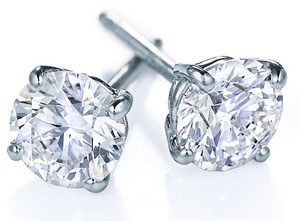

 Buying a set of diamond stud earrings is a significant financial commitment, but also a valuable investment. Diamond earrings typically start around $500 in price and can be as much as $36,000 for a single pair. Before balking at the expensive price tag, consider all of the factors that go into determining the cost of a pair of diamond earrings, and how they affect the price range of such items.
Weight
Diamond weight is one of the primary factors affecting its price. Weight is measured with a unit called carats, and each carat is worth 100 points. For example, if a diamond has 53 points, it is a 0.53 carat diamond. Click here to view just such a pair, available on our website for $508.99.
Diamonds can come in much larger carat weights, such as the 4.02 carat diamond earrings pictured we sell for $27,620.00.
Weight is usually determined by an electronic scale for the most precise accuracy. Carats do not guarantee quality; a diamond with a small carat weight may be of better quality than a diamond with a high carat weight.
Cut
Diamond studs are usually chosen for their sparkle and brilliance. Therefore, the jeweler picks gems for their shine and size as opposed to the color of the diamonds. These factors are determined by the cut of the diamond, which refers to the shape and polish of the stone. The cut of the diamond is what makes a piece of jewelry really shine and sparkle; talk to your diamond dealer to learn more about their process and how they cut diamonds for the highest quality jewelry.
Color and Clarity
Oddly enough, the less color a diamond has, the more expensive it is. Diamonds that are more yellow are often less valuable and therefore lower in price. Diamonds typically fall into one of three categories, ranging from least expensive to most expensive: faint yellow, nearly colorless, and colorless. Colorless diamonds refract the most light, creating maximum sparkle, shine, and beauty. These diamonds are also the most rare and come with a more expensive price tag. Clarity refers to the “inclusions,” or tiny birthmarks on a diamond. The fewer inclusions, the more expensive, pure, and rare the diamond is. More details about clarity can be found here.
Trade-Up Policy
Many diamond dealers have a trade-up policy that allows you to bring in your old diamond earrings to get a price break from a new more valuable set of jewelry. Keep this in mind if you buy a smaller set of diamond studs from your dealer with the hope of purchasing nicer gems in the future. Some dealers (including Mervis!) even offer 100% of the value of your original pair towards your new earrings, so don’t be afraid to think big!
The Bottom Line
You can find diamond stud earrings to fit your carat, clarity, and color requirements at a variety of prices. Speak with your diamond dealer to find the best set of earrings to fit your budget, for diamonds are as diverse and unique as the individual wearing them.
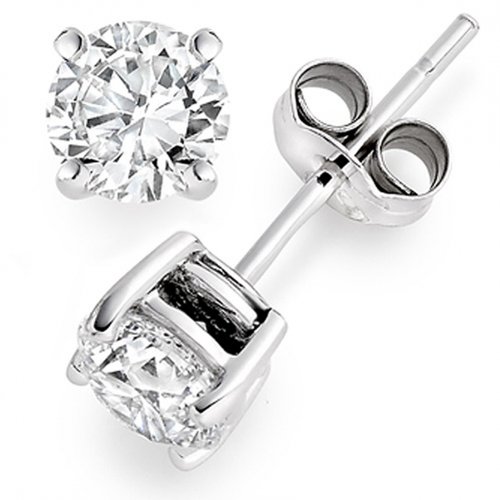 Also known as a butterfly due to its unique shape, this is one of the more popular earring backing types. It consists of a post that inserts into a metal piece behind the ear to hold in place the earring. However, it is known to not be as secure as other backings due to its looseness.
 Also known as a clip post, this combines a typical post with a clip to securely hold the earring. While less likely to lose the earring than a regular push back, they are known to sometimes pinch the earlobe and over an extended time, can become uncomfortable.
  The lever back back uses a piece of metal resembling a fishhook that pushes through the ear. It is then secured to a lever from the the back of the earring. This is known to be a good choice for valuable diamond earrings, even those that are larger sized.
  These backings use a post that works like a screw. The back is screwed onto ridges for a tight fit. While being one of the more secure types of earring backing, those with sensitive ears might wish to avoid these. The threaded post may not be as comfortable as other backings. Furthermore taking them off and on is known to be a bit more involving.
 If you have sensitive ears, jumbo friction backs make a better choice over screw backs. It consists of a small metal piece that gets pushed behind the earlobe onto the earring post, while being secured by friction. The larger size of these backings provides added weight, stability, and security. For even greater security, consider asking your jeweler to add a small plastic disc to the earring back.
  Known for its combination of comfort and security, the la poussette is a viable option that, unlike the friction back, will not loosen over time nor slide off if the earring is pulled. It's composed of a flat metal backing with a small clutch on each side. Both clutches need to be squeezed to release it (which can be done rather quickly), otherwise the earring remains securely in place. The post on the back of a la poussette earring has a groove towards the end of it that makes it very difficult for it to be pulled off unintentionally. Heavier earrings will also benefit from the la poussette since this backing prevents drooping by holding the earring close to the ear. As you might have guessed, this level of engineering does come with a price tag. Most jewelers reserve this type of backing for only their most valuable of earrings.